maker
Among Ancient Ruins: A Father-Son Maker Journey
August 26, 2026 · 8 min read
Among Ancient Ruins: A Father-Son Maker Journey
Shoulder to Shoulder: The Conversation That Opens in the Car
I was behind the wheel on the way to Laodikeia. Since we live in Denizli, this wasn’t a long trip to another city, just a short drive out of town to reach the ruins.
My son sat in the backseat, staring out the window. As we neared the entrance, he spotted the distant columns and asked:
“Dad, why are the columns always spaced the same way apart?”
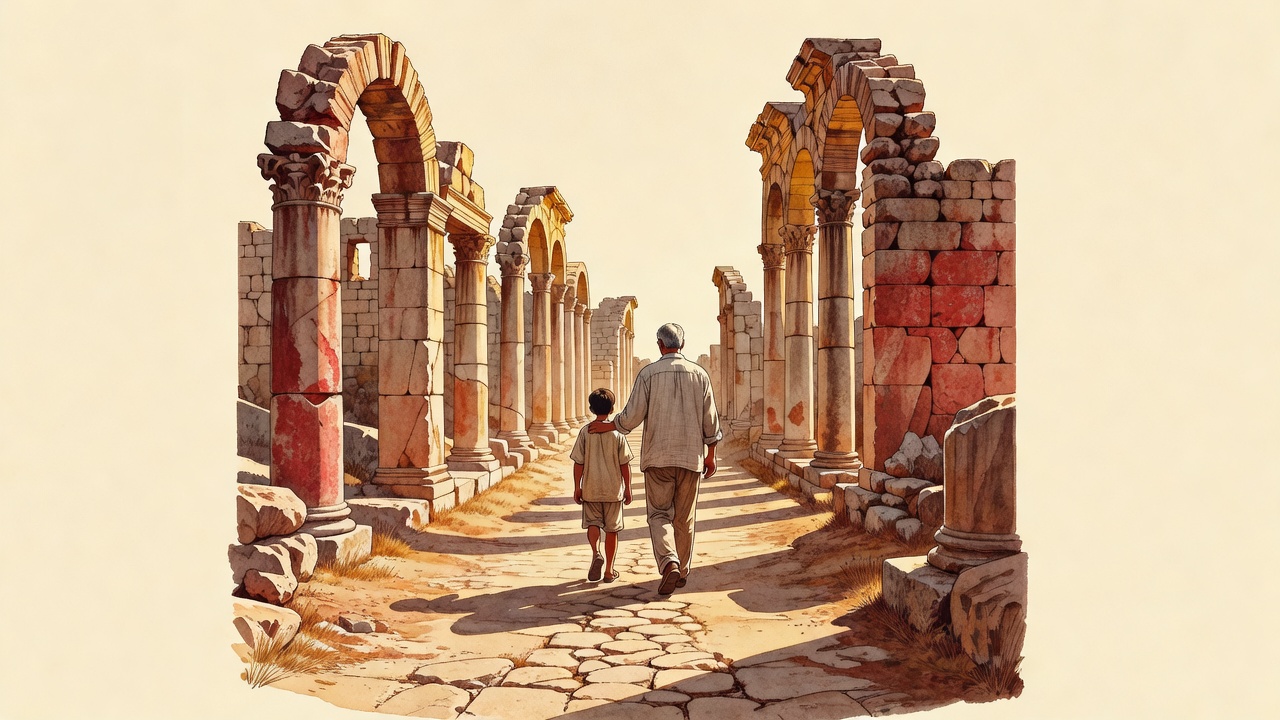
He asked the question in the car, but we didn’t stay there for the answer. After parking, we started walking toward the north gate. Within minutes, the sounds of the road, the engine, and the parking lot faded, replaced by the quiet between the stones. Now, my son wasn’t observing from behind glass. He was moving through the space, examining it up close.
As we walked along the colonnade, he returned to the same question, this time pointing to the gap between the column ahead and the one behind it. “How did they measure this when they built it?” he asked. Then he noticed the theater: “How did they bring water here?” The questions were no longer about a distant view but about the structure we were standing inside.
I didn’t have all the answers. Sometimes I said so outright. “I don’t know, but we can look into it together.” Far from ending the conversation, this opened up space to think, not just about the stones, the distances, or the buildings, but about what they might be telling us.
Soon, we moved from the spacing of the columns to the shape of the theater. I tried to explain that people didn’t just design structures to look good. They had to work, too. The distance between columns, the angles, the overall layout: they were all connected. My son nodded. I don’t know if my answer fully satisfied him, but he kept asking new questions.
That day, I realized something: You don’t always need a special table, a prepared topic, or a long explanation to have a meaningful conversation with a child. Shared curiosity is enough. The walk we started after parking changed the direction of our talk. When we arrived at Laodikeia, the conversation didn’t stop. It shifted. The order he’d seen through the window was now being tested as we moved among the stones.
The Math Behind the Columns: Spatial Thinking in a Child’s Mind
In Laodikeia’s colonnade, the eye doesn’t fixate on a single stone. The column in front frames the one behind it; as the gaps stretch, the street becomes a line, and the line becomes a problem of perspective. My son wasn’t just seeing an “old building.” He was measuring distances, aligning angles, sensing the rhythm of repetition, and figuring out where his own body fit into the pattern.
This is spatial intelligence in action: visualizing how an object looks from different angles, comparing distances, predicting how a part fits into the whole. The rows of columns teach this without a worksheet. A question like “Which column is behind that one?” seems simple, but it pushes a child to think about perspective, overlap, and depth. The theater’s semicircular shape introduces another layer: Where is the center if every seat faces the stage? How does sound travel? Why is the structure curved instead of straight?
It would be wrong to say these effects are automatic. Walking through an ancient city doesn’t turn a child into a future architect on its own. But research shows that spatial skills can be developed through practice. For example, a 2013 meta-analysis by Uttal and colleagues found that spatial abilities aren’t fixed. They improve significantly through different activities. The columns in a ruin can be one of those natural tools. Instead of rotating an abstract shape on a screen, the child thinks through the stone, the space, and their own movement.
Aesthetic judgment works the same way. It’s not a ready-made package. Before saying “this is beautiful,” the eye looks for order. Repeating intervals, aligned structures, and measured gaps create a sense of wholeness in the mind. The golden ratio often comes up here. But not every ancient structure follows it, and many popular stories about it outpace the evidence. A better question for a child is: “Why do you think this building looks balanced?” The answer often lies in relationships, not just measurements.
This is why places like Laodikeia or Hierapolis offer a different mental climate from the modern city. In today’s urban spaces, signs, traffic, ads, and disjointed facades constantly fragment attention. In ancient ruins, despite the decay, a readable order remains. You can still trace where a street leads, which way the theater faces, which axis the columns follow. Chaos doesn’t disappear, but it takes shape.
For my son, aesthetic perception isn’t just about recognizing “beautiful structures.” It’s about sensing why a structure works. The connection between form and function becomes visible in the stone. Years later, when he designs a circuit box, sketches a robot, or builds his own tool, he might be looking for the same thing: not just parts placed side by side, but parts that make a whole understandable.
This perspective turns the ancient city from a relic of the past into a place of active learning. When we start looking for ways to recreate the order we see, the visit becomes something else. For us, that transformation began with a coordinate. I’ve also explored the parallel between building your own tool and another context in my loop engineering essay.
Solvitur Ambulando: How Walking Renews Focus
Ten minutes after entering Laodikeia’s north gate, my son’s steps slowed. My phone was in my pocket, the screen dark. We were walking. Just walking.
I’d put my phone away after parking. Even the habit of checking it never crossed my mind as we moved through the ruins. I didn’t notice how much time passed. Normally, my phone is on silent anyway, but the urge to look at a device in your pocket can linger, even without notifications. That day, among the stones, that impulse vanished. After a while, all that remained was the wind, our footsteps, and the occasional question from my son.
I thought of a 2014 Stanford study by Marily Oppezzo and Daniel Schwartz, which showed that people performed 60% better on creative thinking tests while walking. In the lab, they couldn’t find connections while sitting, but on a treadmill, the ideas came. That day in Laodikeia, we were testing this without a lab, just our own bodies.
Rachel and Stephen Kaplan’s Attention Restoration Theory describes this moment perfectly. Directed attention, the kind we use for screens, notifications and the fear of missing out, is constantly drained. The brain gets tired. In nature, especially in a mildly complex but non-threatening environment, this mechanism gets a chance to rest. Ruins are almost perfectly designed for this: enough stimuli to engage, but not so many as to overwhelm. The stones, columns, horizon, and sound of the wind create what Kaplan calls “soft fascination.”
Twenty minutes into our walk, my son asked a question that caught me off guard:
“Dad, did people really sit in this theater every day? Do you think there was enough room for everyone?”
The question was innocent, but the mental process behind it was clear. He was visualizing the space, calculating capacity, imagining daily life. It was the kind of question he’d never ask in front of a screen, because a screen would give him a ready answer. Here, there was no answer. He had to produce his own as he walked.
Since that day, I’ve noticed something: our long walks through the ruins have measurably extended both of our attention spans. When we get home and work on 3D modeling or write code for the GeoMagnet-Project, we don’t feel the same urge to “check something” as often. It’s as if the mind resets.
Solvitur ambulando: Latin for “it is solved by walking.” The ancient philosophers knew this. No matter the problem, a long, aimless walk could rearrange the mind in unexpected ways.
We do the same in Laodikeia, Hierapolis, Tripolis. Phone in my pocket, screen off. No headphones. Just our footsteps and our thoughts.
I realize how happy this makes me only when I’m walking beside my son in silence, waiting for him to suddenly ask another question. In these hours together, we’re not just showing him ancient cities. We’re opening a space where his curiosity can lead. On your next visit to a ruin, leave your phone in your pocket, walk together, and see where the questions take you.